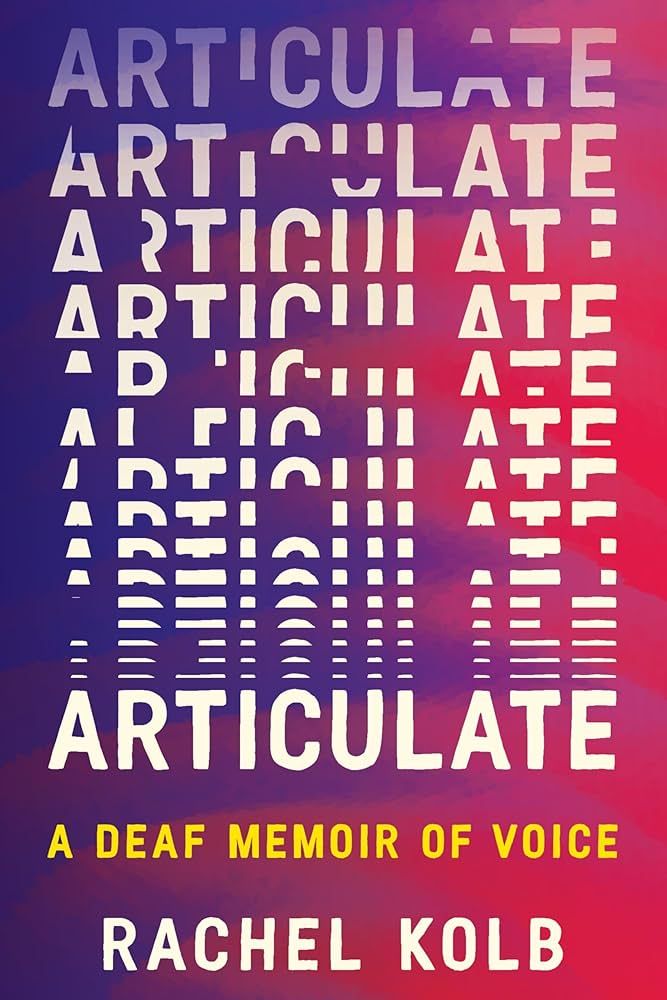
Check out my review of Articulate by Rachel Kolb on my book blog here.
Also, here are the discussion questions I answered for the book club about Articulate:
#1 The biggest impact Articulate had on me as an interpreter was recognizing my own biases. I’ve read a lot of memoirs, biographies, and textbooks by and about Deaf people, and as I read Kolb’s memoir, I kept thinking, “This is the best, clearest book I’ve read by a Deaf person. It’s so, well, articulate!” And then I had to pause; the reason Kolb’s memoir is so articulate is because her parents learned sign language, she worked relentlessly in speech therapy to voice for herself, she got a CI, and she was financially able to attend three prestigious colleges, ultimately earning her PhD. Kolb is exceptional, Deaf or not. Therefore, I realized I need to be careful and consider how her story is unique and that her ability to speak for herself when other Deaf people cannot doesn’t make her “better.” Some Deaf memoirs I read seem simplistic; short sentences, basic vocabulary, very straightforward. These are often people whose second language is English, and they want to get their story out.
Considering someone who isn’t involved in the Deaf community, I do wonder if they would read Articulate and view Kolb as a success story, one that “proves” CIs and speech therapy work. The author mentions how speaking her lectures essentially turns her back on Deaf people who don’t speak and only use sign language, but for the uninitiated reader, that nuance may be missed.
Something that surprised me was how much work Kolb put into organizing her own accessibility. I assumed the hearing party contacted the agency, but because college is different–such as when Kolb wants to go to a lecture that was recently advertised–the hearing party cannot know that Kolb wants to go to an event, so the responsibility falls on her shoulders.
#2 Although it is a short passage, it stuck with me that Kolb felt she had to be 100% in school because interpreters were arranged for her in college–Those interpreters cost money! If she falls asleep in class, won’t the interpreters feel hurt?! On the contrary, her classmates skip and doze all the time. While this is a short passage, it is a systemic bias because she cannot behave like other college students. The onus of perfection is on her to prove herself.
Tangentially, minority individuals are regularly accused of being a “DEI hire” or there for affirmative action reasons. I’ve read memoirs by Black and brown people who note their classmates shunned them in PhD programs, assuming they weren’t qualified because they were a token.
Though I don’t recall Kolb saying people thought she was a sympathy pick for her masters or PhD, I felt like she implied it, and as a result, she has to be grateful to the interpreters, professors, etc. who are assisting her with accessibility, making her college experience different from her peers.
#3 Examples of oppressive harm the author and a second deaf person: Oppressive harm from the author: when she allows hearing people to think she can read lips, and that that is as good as being hearing, to a huge degree. Her choice sets a precedent for her hearing friends’ future interactions with other D/deaf people.
Oppressive harm I’ve seen elsewhere: my own ASL professor was adamant that we not learn anything that wasn’t as close to ASL as possible (we weren’t on the far polar end of ASL, but pretty close to it), which has made it hard for me to interpret for other D/deaf individuals with different signing styles that are more English, use a lot of initializations, include signs for he/she instead of pointing, etc. I understand that my professor wanted us to learn ASL, but by judging other forms of signing (SEE, PSE, etc.), people who don’t tend toward ASL have less access when they get me. That’s why I call a team immediately when someone’s signing is more English!
#4 Communication access is everything because we are social creatures. In fact, a lot of health science now focuses on the negative effects of loneliness, which may be a bigger indicator for morbidity than diet and exercise.
Kolb had the power of access at the silent dinners she and her friends hosted. Yes, it was awkward for her hearing friends, but Kolb was in a power of position to make access happen while other people struggled. The result was she had to slow down and didn’t get any conversation with a great deal of depth, but she was neither exhausted nor left out. She and her Deaf friends later considered the effects of voices off vs. on, providing an opportunity for discussions about accessibility.
In contrast, Kolb had no power during the hearing dinners because people talked over top of each other, the lights were dim for ambiance, and all the burden to communicate was on Kolb. The outcome was her brain tired in short order, and she wanted to go home. She often debated with herself whether she should continue going to these dinners at all, leading to possible isolation.
#5 Task: role-play explaining “hearing privilege” to a person with no experience with the Deaf community, using an example from the book to help them understand. My response:
Rando: “What do you mean, hearing privilege? I work hard for everything I have! Nothing was handed to me!”
Me: “Okay, but do you face hardship because you can’t hear?”
Rando: “No! My ears are fine!”
Me: “Right, so you never had to wonder if you’re going to walk into some place and struggle to get what you need because you can’t hear, right?”
Rando: “Well, I would just type in my phone. That’s why we’ve got these little computers in our pockets. They’re good for something!”
Me: “Okay, but what if the person you’re trying to write to doesn’t know English?”
Rando: “Why wouldn’t they know English?”
Me: “Because not everyone in the U.S. grew up learning English as a first language.”
Rando: *grumble grumble*
Me: “Imagine the grocery store closest to your house with the best prices and best products around were owned by someone from South Africa, and the owners only knew Xhosa.”
Rando: “They wouldn’t stay in business long!”
Me: “Okay, say they had employees who knew English, but you wanted to speak to the manager.”
Rando: “Lika ya do.”
Me: “Sure. We’re talking about immigrants, right? The immigrant experience is close to the Deaf experience. The Deaf community has its own language, culture, history, and ways of doing things.”
Rando: “But people should speak English, so I can understand them!”
Me: “Right! That’s kind of what hearing privilege is like. You can expect that you will walk into any store and be able to hear someone speak English. The fact that you know English and can hear it through your ears means that in the U.S., everything is designed to meet your expectation. You pretty much will never struggle to communicate, and if you do, like with the South African grocery store owners, you can choose to take your business to another store. Easily. Deaf people go to all the stores, and it’s like no one uses their language. They can’t just go to another store because it will be the same thing.”
#6 I have three college degrees in English myself. Two are masters degrees (though you wouldn’t guess it from my first sentence). That moment when Kolb decides to allow an interpreter to voice for her to a professor just after she was accepted into a PhD program, and the interpreter had no clue what Kolb was saying, made me die inside a little. The interpreter made Kolb sound unintelligent and hesitant. When you’re entering a prestigious school at a high level (this I am familiar with; I went to the University of Notre Dame with $0 and no class), everything feels like a giant sunburn. You are hyperaware of the ways in which you do not fit, that you seem lesser, that you need to prove you’re worth the university’s time and money. That you are not stupid. And the interpreter did the opposite. Kolb acknowledges the interpreter was new (!!!), and so I see that less as a failure of the interpreter and more the agency. Why in the world did they send her? I think we need to acknowledge that these social events are not low stakes, and that having the time to ask for clarification (compared to platform interpreting) isn’t good enough in many cases.
On a positive note, I learned the value of giving tidbits, such as which British voice sounded posh or from certain areas, plus other background noise.
#7 One big, wealthy venue near me is the University of Notre Dame, so I thought, “Surely, accessibility must be easy peasy! Let’s see!” I looked up the Debartolo Performing Arts Center, located on Notre Dame’s campus, and while they already explain all the resources you need for accommodations, it’s crazy-lengthy. From the website:
American Sign Language interpretation is scheduled for select Presenting Series performances at the center throughout the year. Requests for additional sign language services must be made through the Ticket Office (574-631-2800) at least two weeks prior to the performance. These requests are subject to availability of an interpreter and are provided at the discretion of management.
To request an Assisted Listening Device or ASL interpretation, please do one of the following:
Add a request in the seating notes when purchasing tickets online, or
*Email your request to Guest Services at pacusher@nd.edu, or
*Submit your request through the contact form under Accessibility Accommodations, or
Ask an usher prior to being seated at your performance or film.
*If sending an email or contact form request, please include your name, event name, and order number (if applicable).
Accessible Seating Requests
Patrons requiring assistance selecting seats in ASL locations, with room for service animals, near power outlets, avoiding stair locations, or any other accessibility requests, should contact the Ticket Office at (574) 631-2800.
Okay, so firstly, what does that mean: “…provided at the discretion of management”? Since when does a manager get to decide whether to follow the ADA? I asked my spouse, who works at Notre Dame, and he noted that it’s a private institution, but I countered that Notre Dame gets government money.
Also, you have to make a note in your ticket purchase (and not know whether you will be accommodated before you pay) and email the ticket office and ask for special seating (but that’s not part of ordering your ticket??). In the email, you must include your order number, which means you might show up for a performance and no interpreter is there. Now, that Deaf person has wasted an evening, their gas, time, etc. I would be confused by all of this. It seems like you would just need to order tickets through the box office when they’re open to make everything smoother, but box office hours are limited to Monday-Friday, 12 p.m.-6 p.m. They expect everyone to just buy tickets online. Plus, the Deaf patron would have to use a video phone with an interpreter, meaning the box office might think something is weird and hang up anyway.
I was overwhelmed by this.
#8 Kolb writes, “Was this what being deaf meant, going out to the playground attached to an interpreter like an anchor?”
One privilege I have is to go anywhere without a strange person hanging around to interpret. Recently, I’ve been interpreting for a deaf high schooler’s after school activities, and it is HARD. Not because much is required of me, but because SO LITTLE is required. This person is in high school, and they do not want to be the teen with the weird lady in her 40’s lurking around. Therefore, I’ve used my power to figure out how to get off this kid’s back while being where I need to be. I learned that instead of following the student, I follow whomever has the clipboard. That would make sense if I gave you more details, but of course I’m not going to. Thus, the student gets to be a teen, hang with friends, communicate how the student prefers, and not look like a “freak” with the interpreter. By supporting the teen’s wishes, I am being an ally and not oppressing him/her by forcing my ideas of accessibility onto this person. I mean, no one wants to stand out in high school. At first, I was missing the very INdirect clues this teen was giving me about backing off, so I realized that to be an ally, I needed to vanish-ish. I asked another interpreter about the situation, and the interpreter replied that I should think of myself like a wheelchair ramp: there for accessibility AS NEEDED.


Leave a Reply