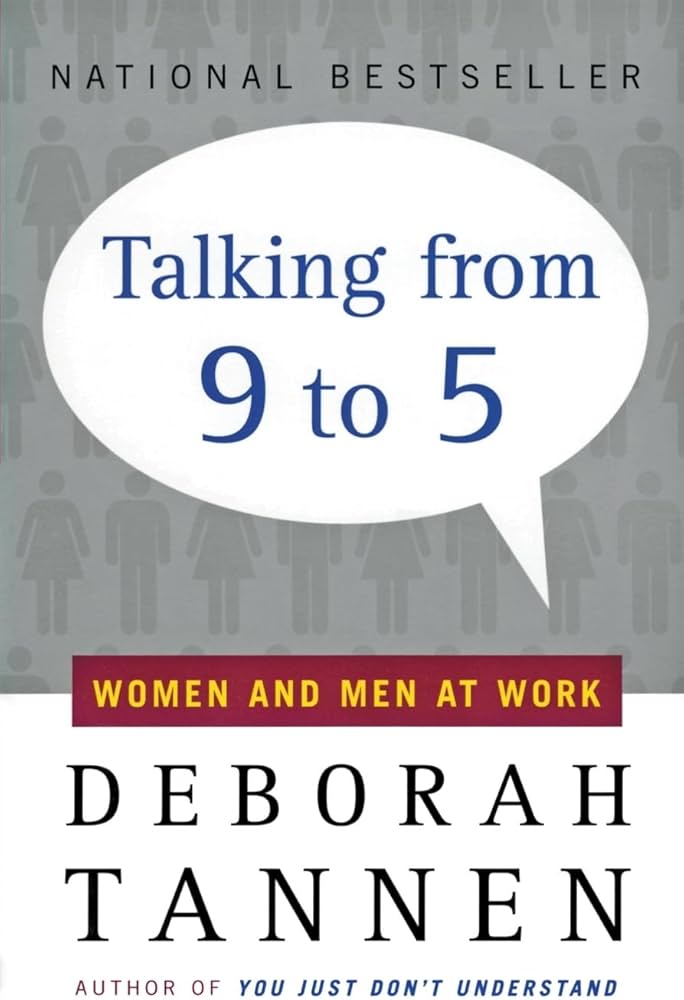
D. Tannen’s (1994) book Talking from 9 to 5: Men and Women at Work addressed a time that preceded a major shift in how we communicate. When this book was published in 1994, we had cell phones, but not in the ubiquitous way we do now, nor did most people have in-home internet. Because information spreads faster now, and we have e-spaces in which we can complain and admonish specific people, or a group, which increases general awareness of iniquities. Thus, while Tannen’s first chapter still rings true, I would argue her research applies to interactions between certain generations of men and women.
For example, when I had a serious issue with a much older, white male colleague and had to speak to my boss because the colleague refused to resolve the problem, the boss, also an older, white male, told me that the disgruntled colleague was “just joking.” However, when I speak with white men closer to my age—Gen X and Millennials—they are aware of power imbalances and tired of playing gender games to fit societal expectations. Of course, that is a generalization, much like Tannen admits she is making. A moment that alerted me to the differences in ways men and women communicate today was a Tweet in which L. Wilford (2021) wrote, “I think millennials killed the ‘I hate my spouse’ genre of humor and honestly I’m proud of us.” Stand-up comedians encouraged the sexes to see themselves as different “animals,” creating sharp delineations. Thus, Tannen’s information is helpful in communicating with different cohorts, but not men by default.
I was intrigued by her research on an autistic Australian author who created two “characters” to mirror what society wants from her. In 1994, no one I knew was diagnosed with autism (although I can look back and know there were autistic people in my community), and our only example was Rain Man. I’m curious how communicating with neurodivergent people upends the patterns society developed for men and women.
In addition, I’m captivated by nonbinary folks and communication. If a person does not identify on a binary, in what way do they communicate? Do they follow the prescribed pattern of submissiveness or one-upmanship? Furthermore, do people identify as nonbinary because they do not want to participate in gender norms? Nonbinary, of course, refers to gender, not sexual and romantic interests.
References
Tannen, D. (1994). Talking from 9 to 5. Virago.
Wilford, L. [@lauren_wilford]. (2021, June 21). I think millennials killed the “I hate my spouse” genre of humor and honestly I’m proud of us. this used to be like half of all jokes [Post]. X.
 Melanie Page
Leave a comment