Emerging Wings: Becoming Myself is a very short book (50 pages) by Melissa Lewis. If you want a brief introduction to what life is like for one person who is not Hearing, this is the book for you. Some authors chose to capitalize Deaf and Hearing, which means they are referring to cultures. We don’t typically think of being able to hear as part of a culture, but it is in contrast to Deaf culture. Deaf people rely on visual cues, are a collectivist culture, are proud when they are part of a Deaf family (generations of Deafness), share a language, use direct communication (instead of hedging or euphemisms), do not value the ability to speak (some D/deaf people can!) and more. In contrast, Hearing culture, if you will, relies more on sound, are an individualistic culture (in America), think deafness is a handicap, share a language and value speech, and tend to soften their point so as not to offend someone.
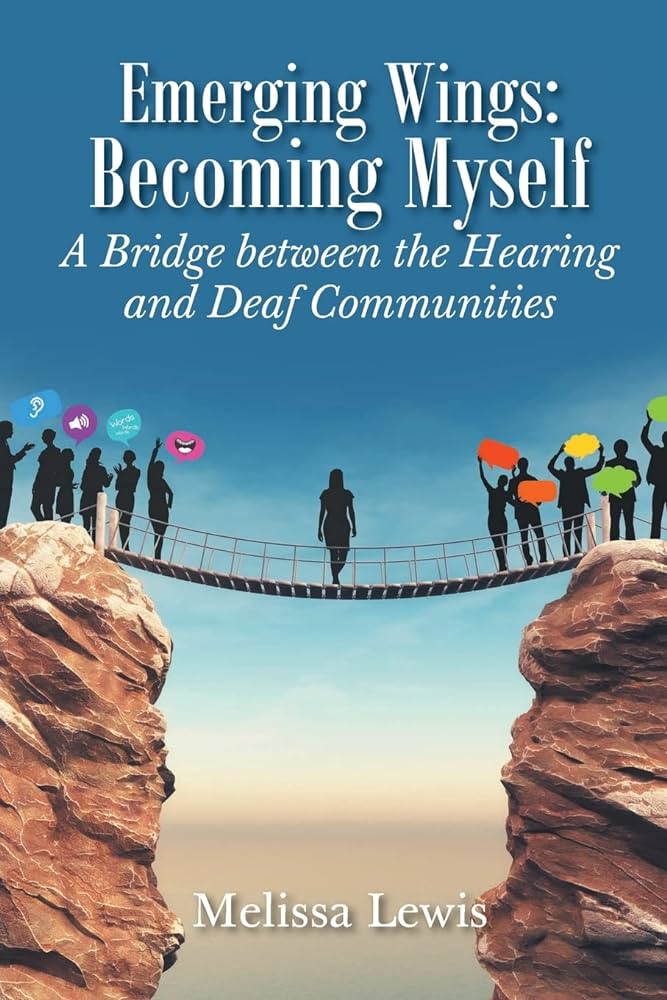
Melissa Lewis was born in 1976, and she opens her book explaining how doctors suggested her parents should send her away and forget about her because she was deaf. She notes that she did not know what her doctor advised until the night of her graduation party, where she celebrated being valedictorian. Her point shines through; the doctor was wrong about Lewis’s abilities because his medical view of deafness informed him that she would be incapable of thriving. Due to how she was raised and support services she received in school, Lewis views herself as a person with “hearing loss” rather than as deaf. In Deaf culture, community members do not view themselves as having “lost” anything, because if you are born without the ability to hear, what did you ever lose? Lewis’s story provides a contrast, a different way of being deaf, to demonstrate the range of experience.
A hotly debated conversation in Deaf communities is whether a person can be part of Deaf culture and have a cochlear implant (CI). Is the recipient of a CI embarrassed about their deafness? Do they want to please hearing people and eschew the Deaf community? Lewis describes her desire to be a “fully practicing attorney in the courtroom without having to request accommodations.” She did hesitate, as the surgery to get a CI means all the ear nerves are severed, so while she used a hearing aid in the past, an unsuccessful CI would mean hearing absolutely nothing. Lewis is direct about her reasoning and experience with a CI, and in her case, she felt she was more herself than a person with “a hearing loss” afterward.
I am not suggesting Lewis turned away from the Deaf community, or, as she puts it, the Hearing world versus the Deaf world. Part of the reason she wanted to be a lawyer was because she was “part of a class action against the health organization in [her] home state that led to statewide interpreting policy changes for people with hearing loss requesting accommodations for medical appointments.” So, while some in the Deaf community may feel apprehensive about Lewis and her CI that helps her be more like a hearing person, her efforts to legalize equal access for d/Deaf and hard-of-hearing people is ongoing. Lewis emphasizes, “I do not affiliate myself entirely with one community. It can be lonely in this aspect as there are not many people like myself to be classified in this group. Some days, I wonder what my life would be like if I was completely immersed in the deaf community.” Interestingly, Lewis reveals that she wishes she could just use sign language and relate to people who understand her, but notes that her “education is more in par with conversing with the hearing community.” Oof. Here, the author reveals she has some internalized audism, implying that D/deaf people are not as educated as hearing people. I also noticed she does not capitalize the D in Deaf, suggesting she doesn’t believe it’s a culture, more just a group.
In general, Lewis demonstrates how she is a woman who identifies as deaf (the medical condition, not the culture) and labels herself with hearing loss (not Deaf gain) and engages in two worlds. While she may not be accepted in the Hearing or Deaf worlds, her experience is something we should take note of as cochlear implant surgeries increase each year. Historically, medical science continues to try and fix deafness, even when the Deaf community says there’s nothing to fix.
*This post was originally published at Grab the Lapels.


 Melanie Page
Leave a comment