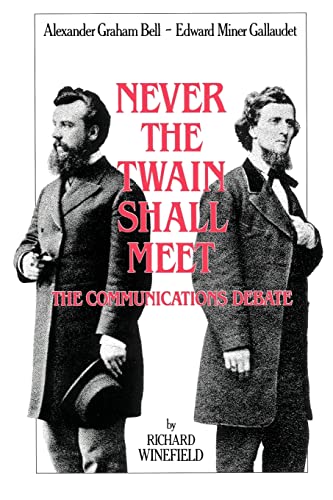
Chapter 1 covers the early efforts of educators of the deaf. Although the conversation about how to educate deaf children has been discussed since ancient Greek times, only in the last 200 years have schools been established and a serious debate about oralism versus manual communication been had. Author Richard Winefield explains that political power often resulted in shaping deaf education. When Spain was a superpower in the 1500s, it affected how deaf children were taught. Same for England after they began colonizing the world. Overall, the French taught manual language, which is what Thomas Gallaudet learned after the English kept their system a secret because the British Braidwood family wanted to start a deaf school in America. Germans were oralists, so once Gallaudet started the asylum in Connecticut, two American educators went to Germany to come back and tout the efforts of oralism. In general, chapter one shows that the “war” between oralists and signers did not start with Thomas’s son Edward Gallaudet and Alexander Graham Bell.
Although I’ve learned about Gallaudet’s efforts many times, I hadn’t realized Spain had a large influence on deaf education, including an educational manual written in 1620. Winefield remains objective in his research, reporting history faithfully, which he wrote in the preface was his goal. As a result, Winefield’s book is rhetorically more trustworthy because he isn’t arguing one side. I had my doubts because in the introduction he describes his personal experiences with a deaf and a hard of hearing student, each of whom needed more tailored education that cannot happen when states outlaw oralism or signing. I do wonder if the U.S.S.R. using oralism changed the debate; Winefield prophesized it would.
Chapter 2 explores how Bell became invested in deaf education. While many think his mother’s deafness was the link, Bell’s father, who was an elocutionist and developed a way to read and pronounce sounds, was the connection. The Bell children could read passages in foreign languages using their father’s system, performing for audiences at times. However, what Bell’s father knew—that Bell’s mother never could read lips—Bell ignored, claiming deaf children could be integrated into society if only they could use English. What he describes as children “mixing” sounds like what we call “mainstreaming” today, or at least the heart of it, which is not segregating any child. However, he also admitted that some teachers were “too oral,” meaning children didn’t know what their teachers were saying, needing the aid of manual gestures to comprehend. Otherwise, the children experienced cognitive delays. One major proponent Bell had was Hellen Keller, who claimed that oralism changed her life after she met Bell in 1887. Still, the author reveals Bell and Keller did not communicate; they exchanged emotions, whatever that means.
Richard Winefield is unable to provide evidence of how clearly deaf students spoke after learning from Bell, nor is it obvious if people deaf from birth compared to late-deafened individuals fared well with Bell’s instruction. In general, we always find ways to segregate members of society, be it their race, income, disability, sexuality, if they’re in prison, etc. Even if deaf people learned to speak from Bell, that does not guarantee societal inclusion, especially at the expense of their mental development, which Bell acknowledges sign language catalyzes.
Chapter 3 looks at Edward Gallaudet objectively. Both Bell and Gallaudet had wealthy backers who made their work in the deaf community possible. Both had deaf mothers; however, Gallaudet’s mother used sign language and could not use speech clearly. Both went to Europe to explore what methods were being used to teach deaf children there. In contrast to Bell, Gallaudet found that the oral method helped some children, causing him to move away from manual language only to the “combined method.” While his family name (Thomas Gallaudet) informed how much people should trust Edward Gallaudet, his journals also reveal that his efforts toward equity were genuine. Most notably Gallaudet agreed with his father that manual language is natural to deaf people and oralism is unnatural.
Thankfully, this chapter cleared up the confusion I had about Edward and Thomas Gallaudet. Where did one man’s work leave off and the other’s begin? Now I know. I was surprised that Edward Gallaudet listened to the needs of deaf children, deciding that the opportunity to learn oralism was important. All children face many learning opportunities that aren’t a good fit for them, but had they not been given the chance, they never would have known. Again, Winefield explained how political savviness influences deaf education, and of course that must be true given that education is mostly funded by the government in the U.S. But it was more Gallaudet’s ability to use pathos—bringing politicians to see the deaf children, dressing like a gentleman, arriving in style, etc.—that influenced Congress the most. What if deaf adults had the same chance to make a case to Congress but didn’t because of their deafness or lack of a wealthy patron? Gallaudet’s willingness to look at all options popular at the time makes me trust him more because once people have all the information, they are empowered to choose for themselves.
Chapter 4 reveals how Bell and Gallaudet went from cordial to bitter with each other. Though they first respected each other, and Gallaudet even offered Bell a teaching position at his newly-founded college, eventually, Bell’s jaded attitude toward people who make promises (the result of the turmoil he experienced after he patented the telephone) meant they no longer trusted each other. Both spoke at the House Appropriation Committee meeting in 1890, Gallaudet to request funding to support the foundation of a teaching school at his college and Bell to argue that deaf adults teaching deaf children would set back deaf education. Eventually, the normal school was set up and is considered one of the best for the education of deaf children as of the writing of Never the Twain Shall Meet. Today, there is a Master’s in Deaf Education program at Gallaudet University.
Hearing and deaf adults are still discussing how to educate deaf children, with deaf schools, mainstreaming, speech therapy, and cochlear implants being major issues. It seems what Bell failed to realize was his exclusion of deaf adults in the conversation, especially his attitude toward deaf teachers, worked against what was historically successful and popular with the deaf community. The author mentions the number of deaf teachers dropping, which I know was a result of the 1880 Milan Conference. It’s interesting that Bell and Gallaudet are having this debate around the time of the Conference. It’s 1891 when Gallaudet asks Congress to fund the normal school, and I wish the author had included more information about any deaf teachers who appealed to Congress—or note if they did not or could not. The schools Bell established were supported by private donors and reserved for children whose families had money. When Bell argued that Congress should not fund public schools like the normal college Gallaudet wanted to develop, he is basically saying that the private sector should oversee educating the public. Yet we know that private sectors must be profitable, or they do not continue. Gallaudet brings up a key point for why I believe that in most cases taking children out of public school is unethical: private schools and homeschooling are largely reserved for families with the means to pay for private education (such as hiring a teacher or foregoing a two-income household). Without a guarantee of public education for all children, democracy flounders. I cannot fathom asking if it is worth it, financially, to educate citizens, especially those who are vulnerable or disenfranchised. Of course it is.
Chapter 5 is largely about Gallaudet’s and Bell’s personal feelings regarding attacks they believe the other made. In their diaries and letters, they ask why the other won’t behave like a gentleman, and thus the debate moves past the political and into ad hominem arguments. Winefield implies Bell wanted to discredit Gallaudet in the eyes of Gallaudet’s Board of Directors. However, Gallaudet felt Bell was willfully misrepresenting the normal school Gallaudet wanted to establish. In the end, the meeting at Flint, MI, severed any chance for the leaders to reconcile. The result, though, had positive repercussions for both Gallaudet and Bell, who were applauded by their supporters for standing up for their positions. Most importantly, the future of deaf children was affected for 100 years, causing disappointment that Bell and Gallaudet chose the American desire to argue politics instead of working toward the greater good.
While this chapter is interesting, it’s hard to understand Bell’s and Gallaudet’s true emotional connection—basically, why are they involved—to the education of deaf children. I wondered if Winefield represented the situation accurately; were Gallaudet and Bell actually champions for deaf education, or were they egotistical? On the other hand, I enjoyed learning about the care Bell and Gallaudet took in how they presented themselves. For example, each took time to correct the wording of a press release or rumor, and it was challenging to meet each other to talk because where they met may imply one or the other conceded his position.
In chapter 6, Winefield explains the influence of the women in Gallaudet’s and Bell’s lives. Bell’s mother, Mabel, denied the deaf community and even actively avoided them. Because she lost her hearing after learning to speak, she easily integrated into “normal” society. Mabel could speak and read lips, so Bell felt his mother was an excellent example of how deaf people could live. However, he wasn’t aware that she wasn’t born deaf. In addition to being deaf, Bell’s mother was an intellectual, an impressive woman amongst women. Bell’s goal was to integrate deaf children, like his mother did. Gallaudet’s father, in contrast, married an uneducated deaf woman, possibly because his mission was to “save” deaf people. Gallaudet saw his mother raise her children and thrive in the deaf community, which led him to believe the goal for deaf children was to live fulfilling lives within the deaf subculture.
Chapter 6 changed my views on Thomas Gallaudet slightly. Winefield implies Thomas only married a deaf woman because he was a “savior” to the deaf community. Thomas and Sophia were not intellectually compatible, suggesting they may have been inured to each other. Winefield claims Sophia was happy, but would she have been happier with someone more in line with her background? While Sophia’s good standing in the community influenced Edward Gallaudet, he did not marry a deaf companion as Bell did. I found it odd that Winefield suggested Edward Gallaudet was gay because he did not want a wife and he had pages torn out of his journal. The author hypothesizes that Gallaudet cherished the deaf community because both they and he knew what it meant to be different, but speculation is not fact.
Chapter 7 should have been titled “How to Make an Ass of Oneself.” Winefield explains that Bell was engaged in deaf education for the betterment of society, which included writing (and discarding) laws that would prevent deaf people from marrying each other. He also considered how selective breeding applied to humans could result in fewer handicap babies, including deafness, but noted that most disabled babies were born to “normal” parents. Bell wanted to stop the rise of a deaf subculture and believed the Milan Conference was proof he was right about training deaf people to assimilate. On the other hand, Gallaudet felt that the combination method was vital for individuals to learn about God and morals. Though Gallaudet’s position comes out looking more valiant, he also did not want deaf people to marry each other.
I was surprised that Bell so easily wrote that deaf people misunderstood his position that deaf people should not marry each other by claiming they weren’t literate enough to “get it.” Before that, how many deaf people supported Bell when he was removing deaf teachers and closing deaf schools? I’ve read a few memoirs by deaf people in which they describe feeling cut off from everyone before going to deaf school where they learned language, found first friendships, and gained self-confidence. Gallaudet, though, seems to be forgiven for his transgressions against the deaf community. I’m wary because I remember that he didn’t want to be an educator at first; he wanted to make lots of money. What did it take to change his heart? Did he feel special because the deaf community admired him as their “savior,” like his father? Admiration or popularity is often a close second to “have lots of money” in lists of things people want.
Winefield’s last chapter describes the impact Bell’s and Gallaudet’s schools of thought have had on deaf students, their parents, and medical practitioners. Parents typically choose a school for their deaf child based on whichever school they encounter first. For instance, if a local deaf child attends an oral school, the parents of a deaf child about to enter school may automatically choose oralism. Medical personnel interfere by threatening to drop a deaf child as their patient if the parents don’t choose oralism. Though oral schools may be popular, deaf children secretly sign in their dorms, under fear of punishment. Winefield does note that we have a human tendency to fear people unlike ourselves, meaning that the efforts of oralists to integrate deaf children into “normal” society is not without cause. The cost, though, is intellectual development in favor of learning to speak, a cost some parents were not willing to pay with their children who went on to learn core subjects—but not to speak.
In this chapter, I really felt the word Never from the title. What Winfield writes about still feels true in 2023. Even people who were born hearing and start to lose their hearing develop a deaf accent, and fully hearing people notice it. They may ask, “Do you have an accent? Where are you from?” My point is humans will always find a reason to judge whether someone different should be welcomed. What if a deaf person learns to “speak beautifully” but is fat or blind or poor? Speaking is only one aspect of a human, and it doesn’t guarantee acceptance into society. At the very least, deaf people who sign and learn a language can continue learning and feeling fulfilled on their own terms. One parent suggested that her son, who went to a school with sign language, couldn’t get a stimulating job, but that’s true of hearing people, too. If you look at counties with a high poverty rate, there is a lot of unemployment, underemployed individuals, and jobs tend to be manual labor. Employment often depends on education and opportunity, for which deaf schools using sign language prepare students.
 Melanie Page
Leave a comment